
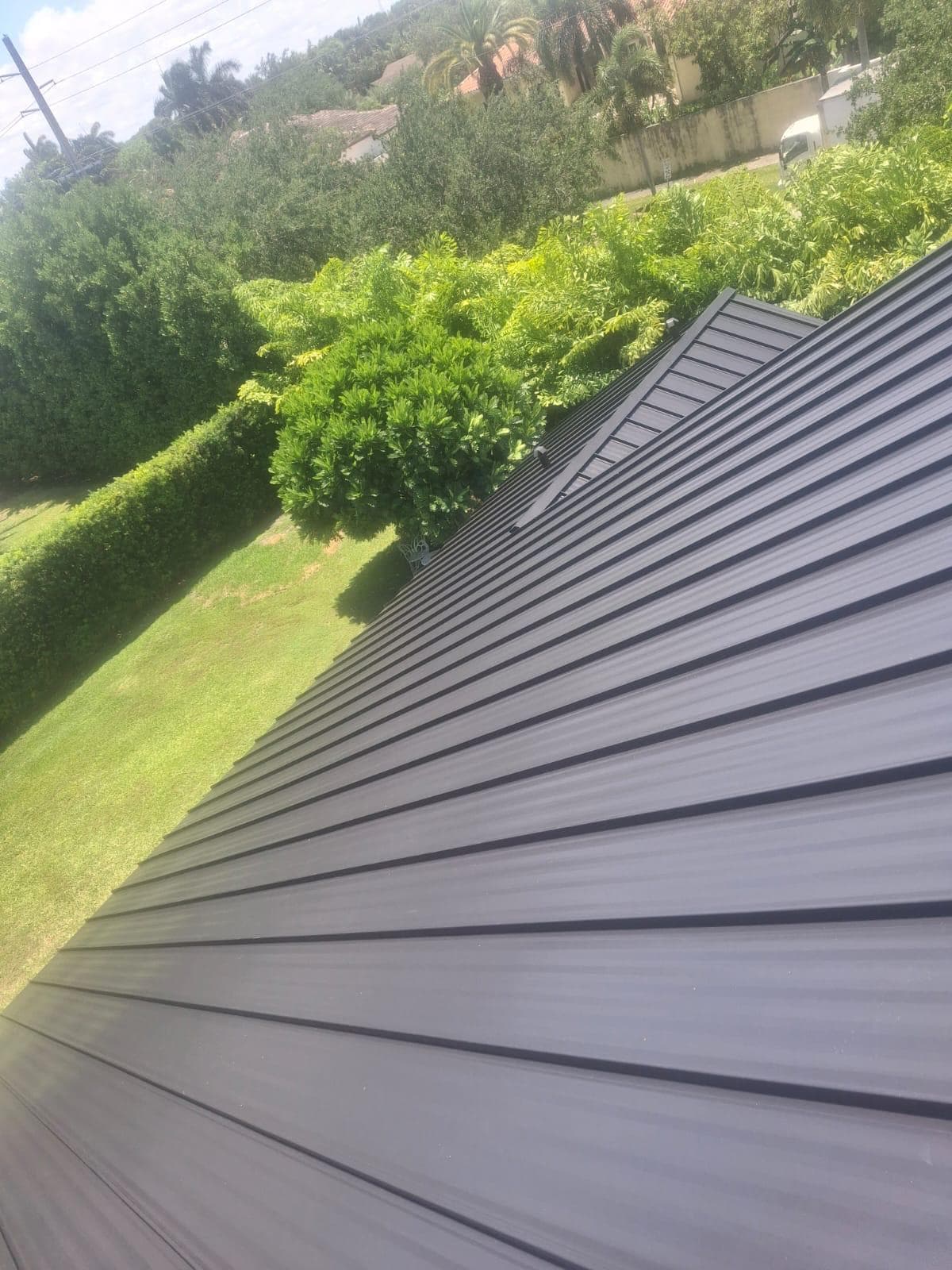
Short answer: metal lasts 40 to 70 years in South Florida and weighs a fraction of what tile does. Tile costs less upfront, suits Mediterranean and Spanish architecture, and runs 25 to 50 years depending on whether it is concrete or clay. If you are staying long term or your structure cannot carry tile, metal wins. If your house was designed for tile and your HOA has opinions, tile wins.
Both are excellent roofs for this climate. Neither is a mistake. The decision usually comes down to how long you are staying and what your house was built to hold.
The Comparison
| Metal Roof | Tile Roof | |
|---|---|---|
| South Florida lifespan | 40–70 years | 25–50 years |
| Typical installed cost | $20,000–$45,000 | $15,000–$35,000 |
| Weight per square foot | 1–3 lbs | 6–12 lbs |
| Wind performance | Excellent | Excellent when properly attached |
| Insurance discount potential | High | High |
| Reflects heat | Yes, significantly | Moderately |
| Repairs | Panel replacement | Individual tile replacement |
| Architectural fit | Modern, coastal, Key West | Mediterranean, Spanish, colonial |
| Noise in rain | Minimal with decking and underlayment | Minimal |
Metal: The One That Outlives The Mortgage
Standing seam is the premium option, with concealed fasteners and raised seams that lock together. Exposed fastener panels cost less and use visible screws with rubber washers, which are the part that eventually needs attention.
Lifespan is the headline. 40 to 70 years in South Florida. There are metal roofs here older than the people worried about replacing them. Compared with 15 to 25 for shingle, you are likely buying your last roof.
Weight is the underrated advantage. Metal runs 1 to 3 pounds per square foot against 6 to 12 for tile. On a reroof over an older structure, this occasionally decides the entire question. If your deck cannot carry tile, reinforcing it costs real money. Metal sidesteps that conversation.
Heat. A reflective metal roof sends solar radiation back instead of soaking it up. In a place where the AC runs 8 to 10 months a year, that shows up on the electric bill. Not dramatically, but consistently, which is the better kind.
Wind. Properly installed standing seam handles hurricane-force wind extremely well. The failure point on any roof here is attachment, not material, and metal's continuous panels with concealed clips give wind fewer edges to work with.
Where it loses. Upfront cost, at $20,000 to $45,000. And architectural fit: a standing seam roof on a 1970s Mediterranean house in Coral Gables looks like a mismatch, because it is one. Some HOAs will not approve it. Check before you fall in love with the idea.
The noise thing you have heard about is mostly a myth from barns. A metal roof over solid decking and proper underlayment is not meaningfully louder in rain than tile. (People who have never had one are very confident about this. People who have one stopped noticing in week two.)
Tile: The One Your Neighborhood Expects
Tile is the South Florida default, and it has earned that. Concrete tile runs 25 to 40 years here, clay 35 to 50 or more.
It fits. Spanish, Mediterranean, and colonial architecture were designed for barrel tile. On the right house, tile does not just perform, it looks correct, and that shows up at resale.
Lower upfront cost. $15,000 to $35,000 against metal's $20,000 to $45,000. On a large or complex roof that gap is substantial.
Repairs are surgical. A cracked tile is a cracked tile. Replace that one. On metal, damage to a panel usually means replacing the panel, which is a bigger job.
Where it loses. Weight, at 6 to 12 pounds per square foot, which can require structural evaluation on a reroof. Shorter lifespan than metal. Brittleness, meaning anyone who walks the roof carelessly creates the next repair. And the underlayment problem below, which applies to tile more than anything else.
The Thing That Ends Most Tile Roofs
Tile does not keep water out of your house. Underlayment does. Tile is the wear layer protecting it.
Concrete tile lasts 25 to 40 years and clay 35 to 50, but a standard underlayment may only go 20 to 30. So most tile roofs in South Florida are replaced with perfectly good tile still on them, because the invisible layer underneath quit first.
This is why a tile roof can look immaculate from the driveway and drip into a closet. It is also why the underlayment spec on your quote matters more than the tile brand. A self-adhered modified bitumen or high-heat synthetic underlayment costs more and buys years.
Metal has a version of this too, but a shorter one: on exposed fastener systems, the rubber washers on the screws degrade under UV long before the panels do. Budget for a fastener inspection every 10 to 15 years. Standing seam avoids this entirely, which is a real part of what the premium buys.
Insurance, Which Is Not A Small Number Here
Florida has some of the highest homeowners insurance in the country, and a wind mitigation inspection is where a new roof pays you back. Both metal and tile can earn strong discounts when properly installed and permitted.
What actually drives the discount is not the material as much as the attachment method and the secondary water barrier. Two tile roofs, same tile, different attachment, get different credits. Ask your contractor exactly what your roof will score on the wind mitigation form before the work starts. If they cannot answer, that is information.
Cost Over Time, Where The Argument Changes
| Metal | Tile | |
|---|---|---|
| Installed cost | $20,000–$45,000 | $15,000–$35,000 |
| Expected life | 40–70 years | 25–50 years |
| Cost per year at midpoints | roughly $590 | roughly $667 |
Metal costs more on the day and less per year. That comparison only matters if you are staying, or if you are selling to someone who understands roofs. Not every buyer does. Many buyers see "new roof" and stop reading.
So the honest framing is this: if you are staying 20 or more years, metal is the better financial decision. If you are selling in five, tile on a Mediterranean house probably returns more of what you spent.
When We Would Tell You Not To Hire Us
If your tile roof is leaking, the tile is intact, and the roof is 20 to 25 years old, ask about a lift-and-relay before anyone quotes a replacement. Remove the tile, replace the underlayment, reinstall the same tile. It costs meaningfully less than a new roof and it is the right answer more often than it gets offered.
If your HOA has an approved materials list and metal is not on it, do not spend three weeks on a metal roof quote. Call the HOA first. We have watched people fall in love with a roof they were never going to be allowed to install, and there is no good moment to deliver that news.
If your roof has 10 good years left, we will tell you that. It is a worse invoice and a better answer.
Frequently Asked Questions
Is a metal roof better than a tile roof in Florida?
For lifespan, weight, and heat reflection, yes. For upfront cost and architectural fit on Mediterranean homes, tile. Both perform well in hurricanes when properly attached.
Are metal roofs loud during rain?
Not over solid decking with proper underlayment. The reputation comes from metal over open framing on barns and sheds, which is a different assembly entirely.
Which is cheaper, metal or tile?
Tile is cheaper upfront, at $15,000 to $35,000 versus $20,000 to $45,000. Metal is usually cheaper per year of service because it lasts longer.
Do metal roofs attract lightning?
No. Metal does not attract lightning, and if lightning does strike, metal is non-combustible and disperses the charge. It is safer than the alternative, not riskier.
How much does a metal roof lower insurance in Florida?
It varies by carrier and depends heavily on attachment method and secondary water barrier, not just material. Ask your agent for your specific number before deciding.
Making The Call
Staying long term, or worried about structural load? Metal. Mediterranean house, HOA with a materials list, or selling within five years? Tile.
Either way, the underlayment on a tile roof and the fastener system on a metal roof are the parts that decide when this roof ends. Spend the argument there.
Call (786) 983-7928 for a free estimate. We will get on the roof, tell you what your structure can carry, and if the answer is that your current roof has a decade left, we will say so and leave. Bad for the quarter, good for the reputation.