
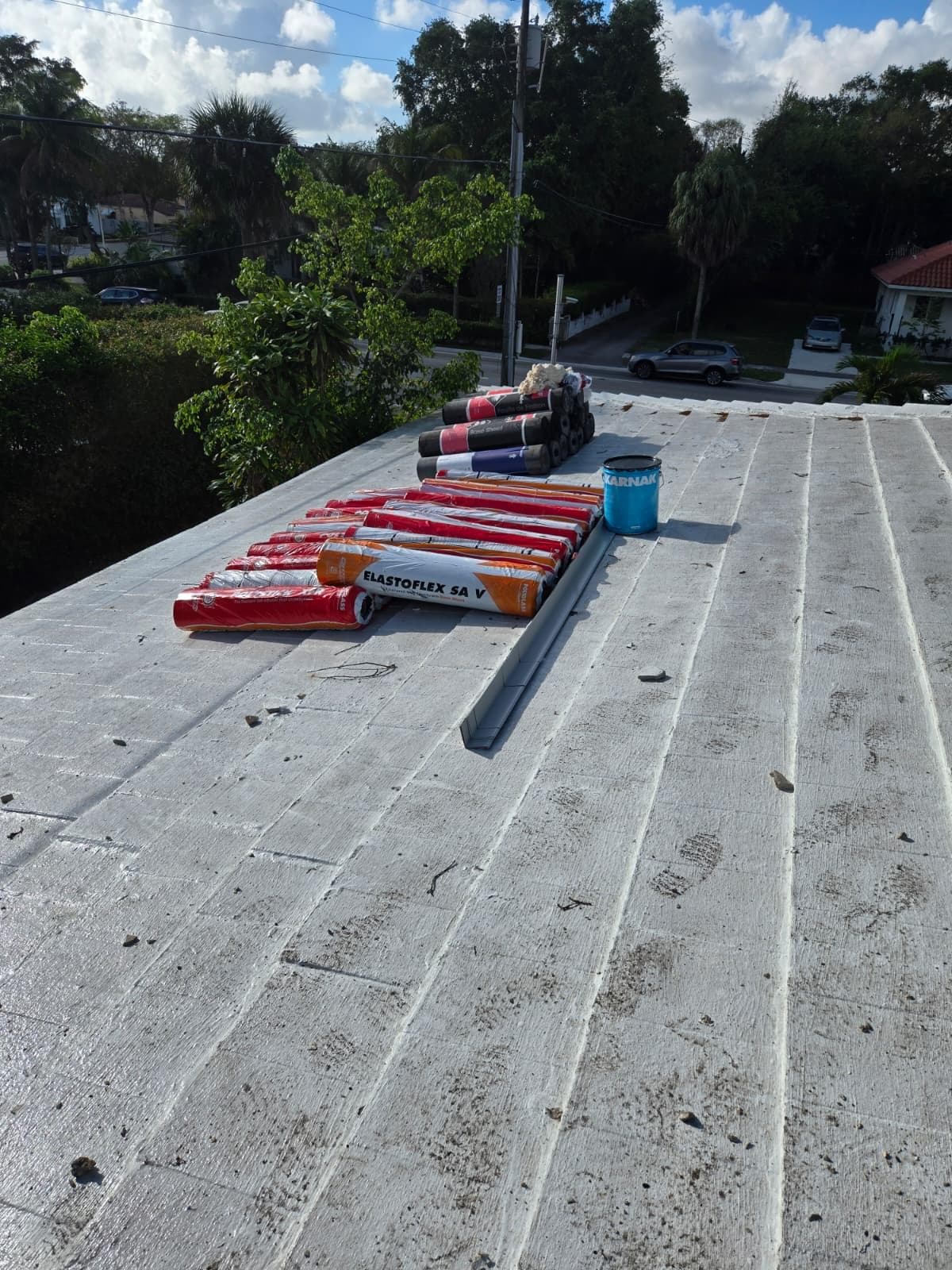
South Florida is one of the hardest environments in the world for a roof to survive. UV intensity, humidity above 70% for most of the year, 62 inches of annual rainfall, salt air within miles of the coast, and a hurricane season that runs June through November — every one of these factors shortens a roof's life. All of them apply here simultaneously.
So when a manufacturer says "25-year shingle," they mean 25 years in a temperate climate with moderate rainfall and the occasional thunderstorm. They don't mean Miami.
Here's what the real numbers look like by material in South Florida.
Roof Lifespan by Material: The Real Numbers
| Material | National Average | South Florida Reality |
|---|---|---|
| Asphalt shingles (3-tab) | 20–25 years | 15–18 years |
| Architectural shingles | 25–30 years | 18–22 years |
| Concrete tile | 40–50 years | 25–40 years |
| Clay tile | 50–100 years | 35–50 years |
| Metal (exposed fastener) | 30–45 years | 20–35 years |
| Metal (standing seam) | 50–70 years | 40–60 years |
| Flat/TPO | 15–25 years | 12–20 years |
The gap between the national average and the Florida reality ranges from 5 to 15 years depending on material. The causes are always the same: UV degradation, moisture cycling, thermal expansion from extreme heat, and the physical stress of hurricane-season wind events.
Why Florida Ages Every Roof Faster
Four factors work on every roof material in South Florida simultaneously.
UV radiation. South Florida gets 250+ sunny days per year. UV light breaks down asphalt binders, oxidizes metal coatings, and degrades sealants. Materials rated for temperate climates are tested in conditions nothing like Miami in August.
Thermal cycling. Roof surface temperatures in South Florida regularly hit 160–180°F on a summer afternoon. Then an afternoon thunderstorm drops 2 inches of rain in 20 minutes and cools the surface by 60°F. Repeated contraction and expansion stresses every joint, fastener, and seal.
Humidity and moisture infiltration. Miami's average humidity sits above 70%. Any small opening — a cracked flashing, a failed pipe boot, a lifted shingle — admits moisture that then cycles through heating and cooling, expanding and contracting, accelerating decay from the inside out.
Hurricane pressure cycling. Even tropical storms that don't directly hit create wind events in Miami-Dade. Negative pressure uplift on a roof during a 60 mph wind event is the equivalent of pulling on every fastener simultaneously. Over decades, this fatigues the system.
Installation quality is the variable that cuts through all of this. A properly installed roof using code-compliant materials handles these conditions well. A roof with improper flashing, incorrect nail patterns, or sub-standard underlayment will fail early regardless of material.
Asphalt Shingles: The Budget Option (15–22 Years)
Shingles are the lowest-cost option — and the shortest-lived in Florida.
Three-tab shingles (flat, uniform appearance) last 15 to 18 years in South Florida with good installation. Architectural shingles (dimensional, overlapping) last 18 to 22 years. Neither approaches the 25 to 30 year ratings on the manufacturer label.
The primary failure mode: granule loss. Asphalt shingles protect via a layer of ceramic granules embedded in the surface. UV and thermal cycling bake those granules loose. When they're gone — you'll see them accumulating in gutters after rain — the underlying asphalt degrades quickly. The roof is effectively in its final years.
Florida's minimum building code also requires specific wind ratings on shingles. In Miami-Dade and Broward (the HVHZ zone), shingles must carry a Miami-Dade NOA certification for wind loads up to 150–180 mph. Budget shingles that pass code in the rest of the country often don't qualify here.
Warning signs your shingle roof is failing:
- Heavy granule accumulation in gutters after rain
- Shingles curling at the edges or cupping in the center
- Dark streaks or algae growth (common with moisture intrusion in Florida)
- Leaks after storms that didn't appear before
- Roof age over 18 years — even if it "looks okay from the street"
Call (786) 983-7928 for a free estimate on shingle replacement.
Tile Roofs: The South Florida Standard (25–50 Years)
Concrete and clay tile are the dominant roofing material in South Florida because they handle the climate far better than shingles. Tile reflects UV rather than absorbing it. It doesn't lose granules. It handles thermal cycling without cracking.
Clay tile is the more durable of the two — clay tile roofs installed 60 years ago in Coral Gables are still functioning. Concrete tile is more common because it costs less, but it's also heavier and slightly more susceptible to freeze-thaw cycling (less relevant in Miami, but a factor in northern Florida).
The tile roof misconception: The tile itself rarely fails. What fails is the underlayment beneath it.
Florida building code requires a high-wind-rated underlayment beneath all tile roofing. That underlayment has its own lifespan — typically 20 to 30 years. When it degrades, the roof starts leaking even though the tiles look perfectly fine from the street. Homeowners see the tile and assume the roof is fine. The inspector who goes up there finds saturated deck boards.
Francisco had this exact experience. His tile roof looked solid — no missing tiles, no visible damage. The underlayment had failed. He spent a year patching leaks before the inspection confirmed the underlayment was compromised across most of the roof. A full replacement was the only real fix.
He paid twice for the same roof — once for the cheap original installation, and again to do it properly. The lesson, unfortunately, is a common one.
Warning signs your tile roof needs attention:
- Missing, cracked, or broken tiles (water infiltrates immediately)
- Leaks that appear only during heavy rain
- Soft spots visible when walking the attic
- Roof age over 20 years with no record of underlayment inspection
Call (786) 983-7928 for a free estimate on tile roof replacement.
Metal Roofs: The Long-Term Investment (35–60 Years)
A properly installed metal roof in Florida is the closest thing to a permanent solution.
Metal reflects UV rather than absorbing it. It doesn't crack, curl, or lose granules. It handles wind pressure better than any other roofing material. And it earns the best insurance credits of any roof type in Florida — some carriers offer 30–50% wind premium reductions for metal.
Two types of metal roofing:
Standing seam metal — the panels interlock at raised seams with hidden fasteners. No exposed hardware to corrode or leak. Lifespan in South Florida: 40 to 60 years with minimal maintenance. The right choice for long-term ownership.
Exposed fastener metal — panels are screwed through the surface. Cheaper to install and still durable, but the fastener penetrations are the weak point. In South Florida's salt air and UV, fasteners and their rubber washers degrade. Lifespan: 20 to 35 years before the fasteners require attention. Fine option, but not as long-lived as standing seam.
Metal carries the highest upfront cost but the best long-term value per year for homeowners who plan to stay 20+ years. For someone who'll sell in 10 years, tile is probably the better value. Call for a free estimate and we'll break down the comparison for your specific home.
Flat / TPO Roofs: The Addition Option (12–20 Years)
TPO (thermoplastic polyolefin) and modified bitumen are the standard materials for flat roofs in South Florida — common on additions, covered patios, garages, and commercial-style residential buildings.
Flat roofs depend entirely on drainage. In South Florida's wet season, standing water is the primary enemy. A properly sloped flat roof with functioning drains lasts 15 to 20 years. A flat roof with drainage issues degrades significantly faster.
Call (786) 983-7928 for a free estimate on flat roof replacement.
The Florida Insurance Factor: The 15/20-Year Rule
Florida homeowners insurers have a roof age rule that most homeowners don't know about until it's a problem.
Many Florida insurance carriers will not write or renew policies on homes with roofs older than 15 to 20 years — regardless of condition. Some require an inspection; others simply decline renewal when the policy renewal data shows the roof is old. This creates a forced replacement scenario: the insurance company is essentially requiring a new roof, regardless of what you'd prefer.
If your roof is approaching 15 years old in South Florida, start planning. Don't wait for a leak or an insurance non-renewal notice.
A new roof also lowers your insurance premium — immediately. Florida homeowners with new roofs (under 5 years old) often see premium reductions of 20–40% compared to the same home with a 15-year-old roof.
My Safe Florida Home Program
The State of Florida operates a grant program that helps low-to-moderate income homeowners fund storm hardening improvements, including roof replacements. Grants can cover up to $10,000 of a qualifying project.
Not every homeowner qualifies, and the program goes through funding cycles. But it's worth checking if you're in a qualifying income bracket. We can tell you whether a project is likely to qualify when we come out for a free estimate.
What to Do If You're Not Sure
Get a roof inspection. A qualified roofer can identify underlayment condition, flashing failures, and deck deterioration that you can't see from the ground or even from the surface of the roof.
The inspection should be free. It should result in a written report. Any contractor who won't put their findings in writing is worth moving past.
Frequently Asked Questions
How long does a shingle roof last in South Florida?
15 to 22 years depending on type (3-tab vs. architectural) and installation quality. Nationally-rated lifespans of 25–30 years don't apply in Florida's climate.
How long does a tile roof last in Florida?
The tile itself can last 50+ years. The underlayment beneath it typically needs replacement at 20 to 30 years. A tile roof that looks fine from the street may have failed underlayment — get it inspected if it's over 20 years old.
What are the warning signs I need a new roof?
Heavy granule loss in gutters (shingles), leaks that appear only during heavy rain (tile underlayment), visible rust or fastener failure (metal), or roof age over the material's South Florida lifespan. Get an inspection — the real condition is usually below the surface.
What's the best roofing material for South Florida hurricane resistance?
Standing seam metal, followed by concrete or clay tile. Architectural shingles are the minimum acceptable option. All must carry Miami-Dade NOA certification in Miami-Dade and Broward Counties.
Does Florida homeowners insurance require a newer roof?
Most Florida carriers won't insure roofs older than 15 to 20 years. Some require an inspection; others simply decline renewal. If your roof is approaching that age, start planning — don't wait for the non-renewal notice.
How much does roof replacement cost in Miami?
It depends on material, roof complexity, and home size. Call for a free written estimate — we'll assess your specific roof and give you a clear number.
How often should I get my roof inspected in South Florida?
Once a year, in April or May before hurricane season. After any named storm that passes within 50 miles of your county. After any visible damage — even minor.
Do I need a permit for roof replacement in Miami-Dade or Broward?
Always. Any contractor who offers to skip the permit is telling you something important about how they operate. Unpermitted roof work voids your insurance coverage and complicates resale.
If your roof is over 12 years old and you haven't had it inspected recently, call us at (786) 983-7928 for a free inspection and estimate. We'll give you an honest report — not a sales pitch.
And if it turns out the roof is fine and just needs a repair: that's what we'll tell you. A roof that doesn't need replacing is not a problem we're looking to solve for you. (We have enough real ones to keep us busy.)
Want to know what a replacement will cost for your specific home? Use our free Roof Cost Calculator — enter your ZIP code and address and we'll put together a real estimate within a few hours.