
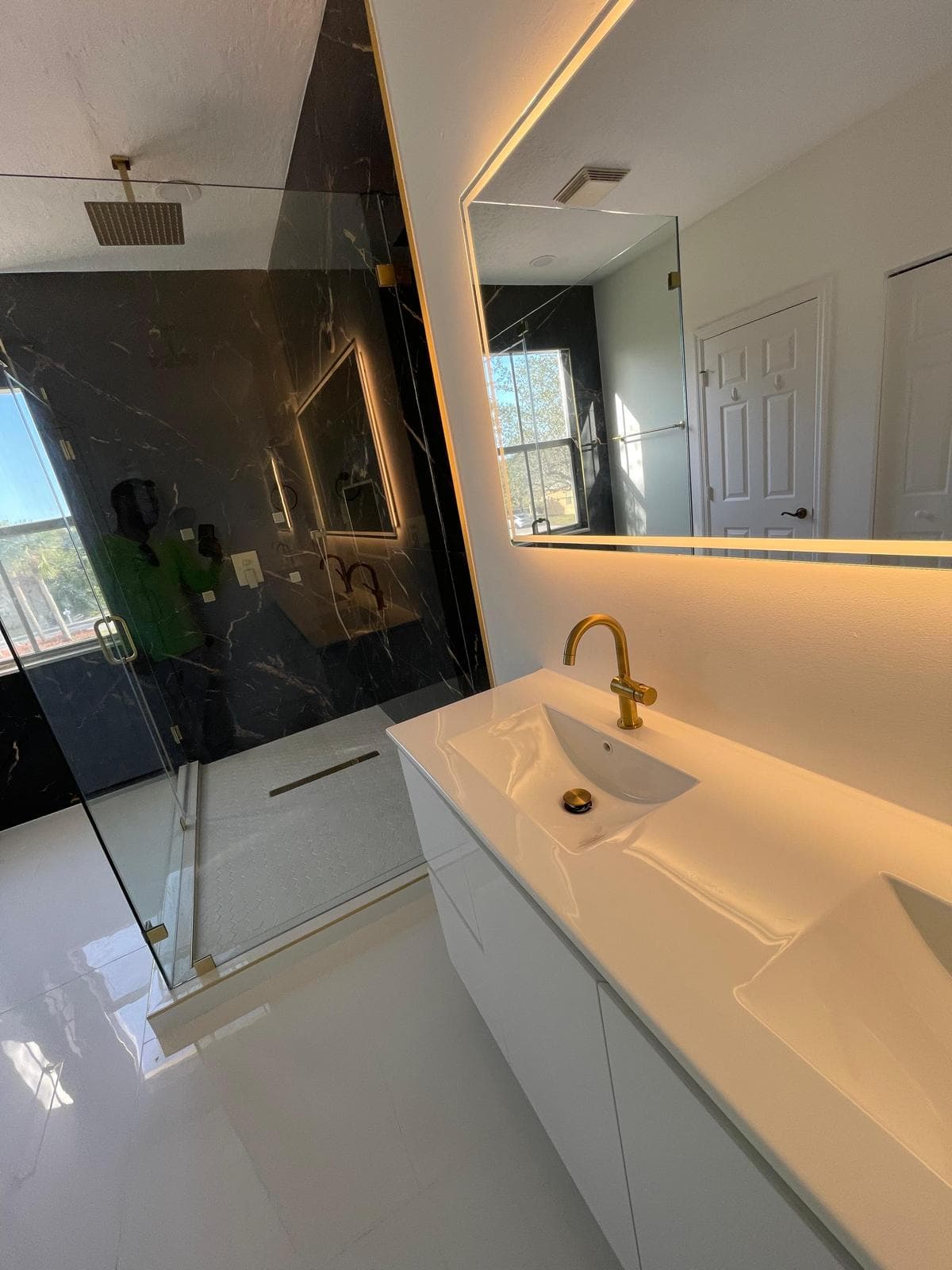
The best flooring for a South Florida home is large-format porcelain tile or SPC luxury vinyl plank — both are 100% waterproof, stable in high humidity, and built to survive the climate. Everything else is a compromise. Some compromises are acceptable. Some aren't.
Here's the full breakdown.
Porcelain Tile: The South Florida Standard
Porcelain tile is non-porous. Humidity doesn't affect it. Water doesn't affect it. UV doesn't affect it. You can pour a bucket of saltwater on porcelain tile every day for 30 years and the tile will look exactly the same. That's why it's in the majority of South Florida homes.
Large-format porcelain (24x24, 24x48, 32x32) has become the dominant aesthetic choice in Miami over the past 10 years. Clean lines, minimal grout joints, modern look. It's also harder to install correctly — it requires a very flat substrate, and a poorly installed large-format tile floor will crack at the grout lines within a year. Don't let a contractor install 24x48 tile on a substrate that hasn't been properly leveled.
Cost installed: Varies by tile size, material, and layout complexity. Diagonal patterns and large-format tiles require more skill and time to set. Call for a free estimate.
Lifespan: 50+ years with proper installation. Porcelain outlasts every other flooring material.
Downsides: Hard underfoot — uncomfortable for long periods of standing. Grout joints require sealing and periodic maintenance. Cold underfoot in winter (a problem approximately 20 days a year in Miami — manageable). Cracked or chipped tiles are noticeable and need matching.
Best for: Living areas, kitchens, bathrooms, entryways, entire homes, and anywhere water is a possibility.
SPC Luxury Vinyl Plank: The Wood Look Without the Problems
Putting solid hardwood floors in a Miami home is an experiment in what sustained humidity does to wood. Short answer: it expands, gaps, buckles, and warps. The experiment ends badly.
SPC (Stone Plastic Composite) vinyl plank is the evolution that actually works here. SPC has a rigid stone-composite core that is dimensionally stable even in high-humidity environments. It doesn't expand or contract meaningfully with humidity changes. It's 100% waterproof throughout — not just the surface.
Standard LVP (Luxury Vinyl Plank with a foam or rubber core) is good. SPC is better for South Florida specifically because of that dimensional stability. Look for it when specifying.
Cost installed: Varies by product quality and installation complexity. SPC typically costs more than standard LVP due to the superior core material. Call for a free estimate.
What to look for:
- 20-mil+ wear layer (the thick top layer that handles traffic and scratching)
- "100% waterproof" certification — not "water resistant"
- SPC core for South Florida; avoid foam-core LVP in areas with significant humidity fluctuation
Best for: Bedrooms, living areas, rental properties — anywhere you want the warm look of wood without wood's problems.
Can install over existing tile: SPC and LVP float over the subfloor, meaning they can often be installed directly over existing tile without demo. This skips demolition entirely and is a significant advantage in South Florida condos where tile-over-tile is common.
Lifespan: 15–25 years with quality product. Less durable than tile but significantly less expensive to install and replace.
Engineered Hardwood: Use Carefully
Engineered hardwood — real wood veneer on top, plywood core underneath — handles humidity better than solid hardwood. But it still has real limits in South Florida.
In bedrooms and formal living rooms with consistent AC, engineered hardwood works and looks beautiful. In kitchens, bathrooms, laundry rooms, or any ground-floor room in a flood-prone area — it doesn't. The plywood core absorbs moisture under sustained exposure and warps or delaminate.
If you want the authentic look and feel of wood and you're willing to maintain consistent indoor climate control: engineered hardwood is a reasonable choice for the right rooms. If you can't guarantee climate consistency — vacation home, rental property, rooms near outdoor areas — go with SPC instead.
Cost installed: Varies by wood species and product quality. Call for a free estimate.
Ceramic Tile vs. Porcelain Tile
Both are good. Porcelain is better for South Florida:
- Porcelain is denser (lower water absorption rate — typically under 0.5%)
- Ceramic absorbs slightly more moisture, making it more susceptible in high-humidity environments
- Porcelain is harder and more scratch-resistant
For bathrooms, showers, and outdoor areas: porcelain only. For interior living areas where the budget is tight: ceramic is acceptable.
What to Avoid in South Florida
Solid hardwood: Expands and contracts with humidity. Miami's swings from 90% summer humidity to 60% winter humidity are too extreme. You'll have seasonal gaps and potential buckling. Not recommended for any room.
Standard laminate: The surface is moisture-resistant but the core is a wood composite that swells when moisture gets underneath. One leak, one tropical storm flooding, one humid summer with a poorly sealed edge — and the floor is ruined. SPC vinyl gives you the same look without this risk.
Wall-to-wall carpet: Carpet holds humidity, harbors mold spores in South Florida conditions, and is nearly impossible to dry properly after any water intrusion. If you inherit carpet in a South Florida home, replace it. Reserve carpet for second-floor bedrooms with excellent ventilation, and nothing else.
Bamboo: Often marketed as an eco-friendly hardwood alternative. In South Florida's humidity, bamboo behaves like wood — it swells, warps, and gaps. Avoid.
Room-by-Room Recommendations
| Room | First Choice | Second Choice | Avoid |
|---|---|---|---|
| Living room | Porcelain tile | SPC vinyl | Carpet, laminate |
| Kitchen | Porcelain tile | SPC vinyl | Hardwood, laminate |
| Primary bedroom | SPC vinyl | Engineered hardwood | Carpet |
| Bathrooms | Porcelain tile | Porcelain tile | Everything else |
| Laundry room | Porcelain tile | SPC vinyl | Anything wood-based |
| Guest bedroom | SPC vinyl | Porcelain tile | Carpet |
| Entryway | Porcelain tile | Porcelain tile | — |
| Rental property | SPC vinyl | Porcelain tile | Carpet, hardwood |
| Flood zone home | Porcelain tile | SPC vinyl | All others |
Flooring by Material
| Material | Best For | Relative Cost |
|---|---|---|
| Porcelain tile (standard) | Bathrooms, kitchens, main living | Moderate |
| Porcelain tile (large format) | Open-plan living, primary areas | Higher |
| SPC vinyl plank | Bedrooms, rentals, humid rooms | Lower–moderate |
| Engineered hardwood | Bedrooms, formal areas with AC | Moderate–higher |
Frequently Asked Questions
What's the most popular flooring in Miami right now?
Large-format porcelain tile (24x48 in light gray or warm white) for primary areas; SPC luxury vinyl plank for bedrooms and rental properties. Both have grown substantially in the past five years as homeowners move away from laminate and standard LVP.
Can I install new flooring over existing tile?
SPC vinyl plank: yes, in most cases. It floats over existing surfaces and requires minimal prep. Tile over tile: possible but adds height — check door clearances. Hardwood or engineered wood over tile: not recommended.
How long does flooring installation take for a typical South Florida home?
Porcelain tile in a 1,500 sq ft home: 4–7 days including layout and grout cure time. SPC vinyl plank: 1–3 days. Engineered hardwood: 3–5 days.
Is radiant heat flooring worth it in South Florida?
Almost never. You'd use it 15–20 days per year at most. The added installation cost doesn't return in a climate where heating is a seasonal footnote.
What's the best flooring for a South Florida rental property?
SPC vinyl plank. It handles tenant wear, pets, humidity, and occasional water events. It's cheaper to install than tile and easier to replace individual sections. Porcelain tile lasts longer but costs more upfront and takes longer to install between tenants.
Does flooring affect my homeowner's insurance in Florida?
Not directly. But if your home is in a flood zone, insurers care about what materials you've used when assessing claims — waterproof flooring (tile, SPC vinyl) is generally easier to remediate after a water event than wood-based products.
Call us at (786) 983-7928 for a free flooring estimate — Monday through Saturday, 8am to 7pm. We'll measure your space, show you material samples, and tell you honestly whether installing over your existing tile saves enough money to be worth it.
And if the existing tile is actually in decent shape and just needs a cleaning and regrout — we'll tell you that too. Not every floor problem requires a new floor. (Grout, it turns out, is doing a lot of work in this city.)